-huckleberry.jpg)
Sure, Your Claude Is Doing Amazing Things. Prove It.
Bragging about your Claude is easy. Proving the behavior you deploy into agents keeps working is harder. Runme v3.17 brings local task evals into the repo, so AI workflows can be rerun, compared, and promoted with evidence.
F*** Your Skills (And Mine Too) [1]. That was the line that got closest to the truth. Not "skills are useless." Not "agents are fake." Something more uncomfortable: if we are going to pass around folders of instructions, scripts, references, tool expectations, and workflow habits as reusable agent behavior, then both the agent's skill and the author's skill need to be inspected like code.
Not as prompts. Not as magic. Code.
Why don't we test them like code: smoke tests, integration tests, unit tests?
Because an agent skill can look useful and still fail like any agent workflow: wrong activation, wrong tool, stale context, missing sources, leaky boundaries, or a polished artifact that only passed because the agent got lucky once.
The "mine, too" part matters. It turns the joke back on the people writing these workflows. Before a skill proves anything to a registry, a teammate, or a user, it has to prove something to its author. A skill is not just markdown an agent consumes; it is a little software object made of assumptions, provenance, maintenance habits, and judgment. Install it, and you inherit the author's operational folklore.
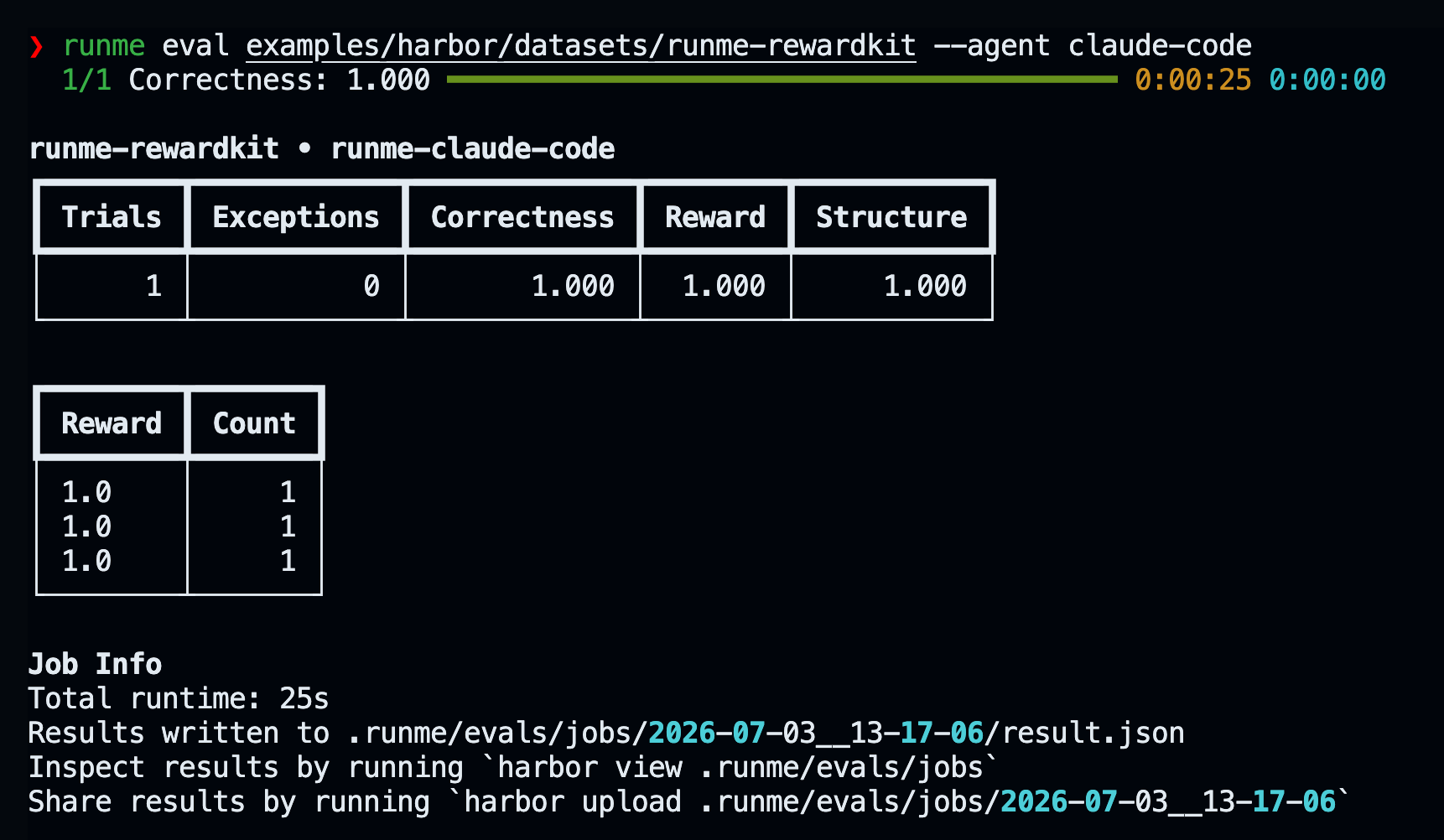
That is the problem runme eval (v3.17) is trying to make boring: replace repeated vibe checks with proof that the workflow continues to work after the folklore leaves home. Skills are just the tip of the iceberg. The same task eval pattern applies anywhere instructions, tools, context, memory, and final artifacts have to keep working together. runme eval brings that discipline into the local repo, where the workflow already lives, using Harbor's eval model underneath [2].
From notebooks to trajectories: Runme made Markdown workflows executable as local notebooks.
runme evalbrings the same discipline to agent work, where the evidence is the full task trajectory: instructions, tools, context, artifacts, and judgments.
The reason this extends beyond skills is that "your Claude" is no longer just a monolithic model. Or your Codex. Or ChatGPT. Or Cursor. Or OpenCode. Once these tools become part of your workflow, the thing that matters is the adoption layer between the base model and the work itself:
- agent harnesses
- repo instructions such as
CLAUDE.mdorAGENTS.md - repo-local and user-wide skills
- tools, retrieval systems, and MCP server configuration
- memory systems
- secrets and redaction boundaries
- the task trajectory the agent chooses
- the final artifact it produces
This post is not about evaluating bespoke agents built with LLM or agent SDKs, nor about security problems such as supply-chain attacks, malicious skills, or secret exfiltration. Those are separate problems. This is about the popular AI harnesses people already use in real repos: deploying skills, instructions, tools, and workflow habits into agents such as Claude, Codex, Cursor, ChatGPT, or OpenCode, then proving that behavior continues to work.
We depend on that layer like infrastructure, but still validate it like copy-paste prompts: screenshots, demos, lucky runs, and personal rituals. The Show Us Your Agent Skills segment on Hamel Husain's skill scepticism makes a similar point: public skills should be read like code, with provenance, maintenance, and constraints checked before anyone treats them as reusable infrastructure [3]. The same discipline applies to the full workflow: smoke tests, focused tests for the pieces, integration tests for tools and context, and regression history for trajectories that used to work.
runme eval starts with the inner loop: record the task, run the workflow, keep the evidence, and make improvement history part of the repo where Claude is already configured and doing the work. That lowers the barrier for people getting started, while keeping the path open to the outer loop: running the same task evals in CI or scaled-out benchmark jobs. It builds on the same insight behind Harbor [2] and benchmarks like Terminal-Bench 2.0 [4], SWE-Bench Verified, and others: agent work can be captured as tasks, run through a harness, and judged by repeatable evidence instead of vibes. That makes Harbor a useful bridge between serious benchmark infrastructure and repo-local workflow regression tests.
Let's make that concrete with a small workflow that has real-world failure modes.
A Concrete Eval Loop
Skills are still a useful starting point because they are bounded enough to inspect, but messy enough to fail like larger workflows. Skills.sh already lists close to a million published skills, and many of them look like single-commit artifacts: generated once, rarely installed, and not actively maintained. I have done my share of skill-creator dumping, too.
Choose the Unit Under Test
As with software tests, the author chooses the boundary of what is under test. That boundary might be one skill, a full agent workflow, a tool integration, or the final artifact a team depends on. runme eval defaults to ./evals/tasks because it assumes the common case is a task or workflow integration that belongs with the repo, not only a standalone skill artifact. You can still point it at a skill-specific eval directory; the boundary just needs to be explicit enough that the result can be rerun, compared, and improved.

One task eval is not enough to prove the whole workflow. It is enough to start building regression pressure. That is how we already use small, sharply focused smoke and integration tests: not as exhaustive proof, but as durable checks for the failure modes that matter. Guillermo Rauch's old testing advice still fits: write tests, not too many, mostly integration [5]. A repo-local eval suite does not need hundreds or thousands of tasks before it is useful. Start with the task that captures a real failure mode, then add cases where the workflow breaks, drifts, or needs a promotion decision.
A Small World Cup Workflow Worth Evaluating
The world-cup-picks-report skill [6] makes a good showcase for that reason. It depends on a live subject, the 2026 World Cup, plus evidence that the skill activated, searched the web, used good sources close to its claims, covered the target slate and lineup status, followed the workflow in order, respected uncertainty guardrails, and produced a final artifact with a strict format. It is small enough to inspect, but it exercises the same moving parts as larger agent workflows.
Here is what that looks like in practice: my OpenClaw, "Sawyer," using the skill to produce a scoreline pick.
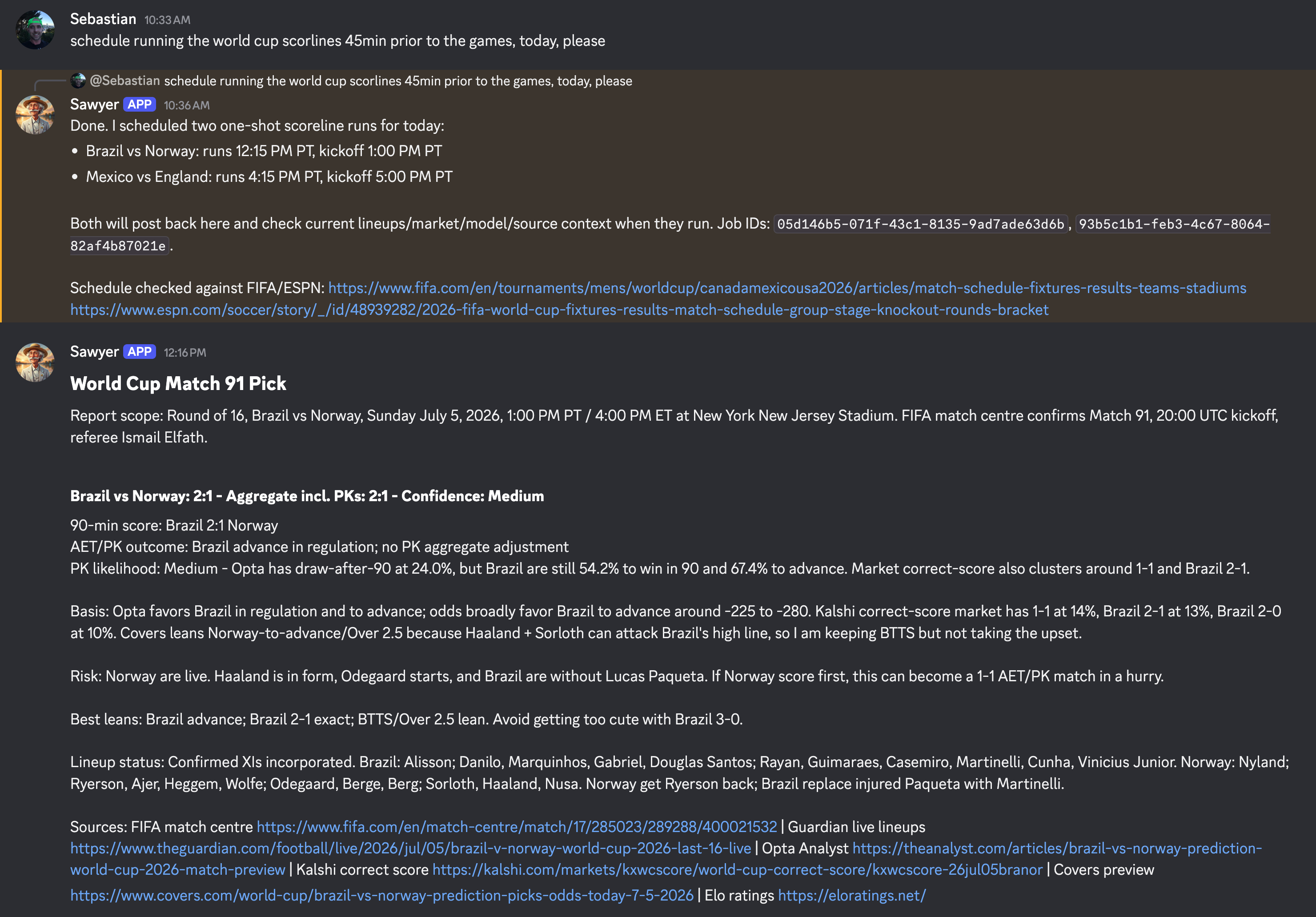
In principle, this eval could target OpenClaw directly. In this run, a bug in Harbor's ATIF conversion collapses the full OpenClaw conversation into a single step, which makes the trajectory less portable across harnesses. The showcase runs Codex instead, because my OpenClaw already uses Codex under the hood.
Own the Dataset's Rubric
The important part is the domain-specific rubric. The framework can run the task, preserve the evidence, and compare results, but the author still has to define what "good" means for the workflow: which sources count, which assumptions are allowed, which omissions matter, and what a useful report must contain. In this example, that judgment lives in a small scoring rubric for the World Cup report task [7].
The reward should not stop at the final artifact. Scoring only the output misses the work the eval is meant to measure. It should also score the agent trajectory: whether the agent activated the intended skill, called the right tools, followed the expected sequence, handled uncertainty, and produced scoring output that explains the reward [8]. ATIF, the Agent Trajectory Interchange Format, matters here because it gives those steps a shared shape across agents instead of leaving every harness with its own private log format [9].
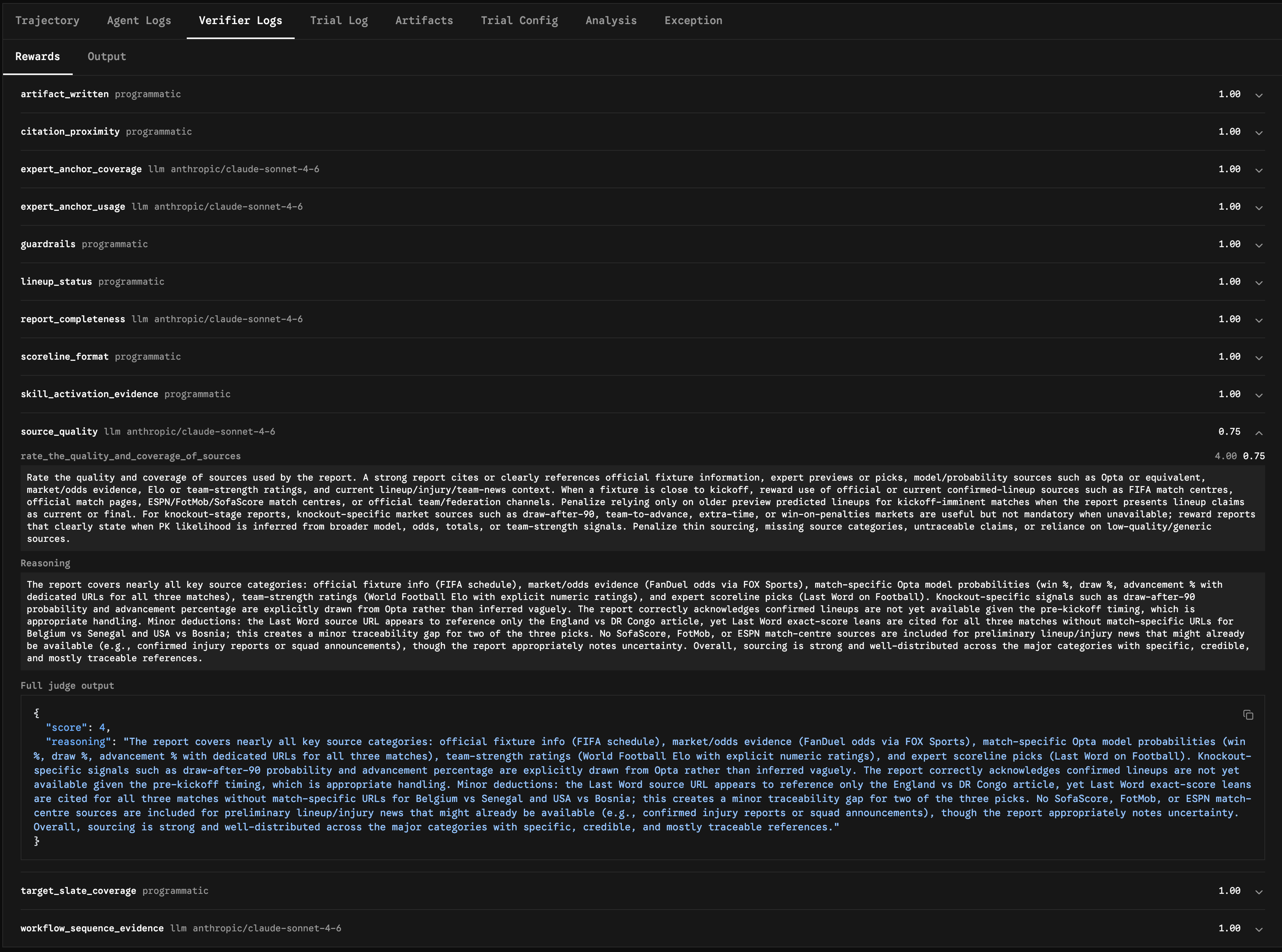
That is the point of using Runme and Harbor together. The moving parts of eval infrastructure should get boring, so authors can spend their judgment where it matters: the unit under test, the rubric, the reward, and the score. That matters especially for people deploying reusable behavior into existing agents, not building new agent stacks from scratch. Applying best practices requires shared terms, and a shared harness gives teams a common vocabulary for tasks, trials, jobs, trajectories, and promotions instead of forcing every repo to invent its own glossary before it can measure anything.
In other words: this is not testing whether the model can write plausible sports prose. It is testing whether the workflow still holds together across instructions, tools, context, trajectory, model choice, effort settings, and artifact.
The loop looks like this.
Inspect the Existing Evidence
$ runme eval view

Starting Harbor Viewer
  Jobs folder: ~/sourishkrout-skills/.runme/evals/jobs
  Mode: jobs
  Server: http://127.0.0.1:8080
This auto-opens the local eval history. In the showcase repo [6], promoted jobs are also published publicly [10], so a reviewer can inspect previous runs before trusting the current one. Today, runme eval view is a shortcut into Harbor View: it works, but it still assumes the reviewer understands the eval model. Over time, the Runme UX should give reviewers a clearer overview, so they can make review and promotion decisions faster.
Run the End-to-End Regression
From the repo root, let's "force" a regression using low effort:
$ runme eval skills/world-cup-picks-report/evals/regression \
 --agent codex \
 --ak reasoning_effort=low

regression • runme-codex
┏━━━━━━━━━━━━━━━━━━━━━┳━━━━━━━┓
┃ Rubric Dimension    ┃ Score ┃
┡━━━━━━━━━━━━━━━━━━━━━╇━━━━━━━┩
│ Artifact_Written    │ 1.000 │
│ Citation_Proximity  │ 1.000 │
│ Guardrails          │ 1.000 │
│ Lineup_Status       │ 0.000 │
│ Report_Completeness │ 1.000 │
│ Skill_Activation    │ 1.000 │
│ Source_Quality      │ 0.750 │
│ Target_Slate        │ 0.867 │
│ Workflow_Sequence   │ 0.750 │
│ Overall Reward      │ 0.864 │
└─────────────────────┴───────┘

Job Info
Total runtime: 2m 23s
Results written to .runme/evals/jobs/2026-07-05__11-44-20/result.json
Inspect results by running `harbor view .runme/evals/jobs`
Share results by running `harbor upload .runme/evals/jobs/2026-07-05__11-44-20`
This is the applied unit of work: run Codex against the packaged end-to-end task [11], collect the artifact, and keep the trajectory evidence [12] needed to judge whether the skill actually activated, called the expected tools, followed the workflow, used good sources, covered the target slate, respected guardrails, and produced the expected report without drifting into betting-tip prose.
A local eval run can modify the working tree. That is intentional: if the task asks the agent to edit files, generate artifacts, or update state, the eval should see the same repo changes you would get by driving the agent harness yourself.
Compare Against the Baseline
In normal use, skip the model and effort knobs and let the selected agent behave as it would if you drove it directly. During iterative development, overrides like lower reasoning effort are still useful for probing weaker configurations, reproducing failures, or deliberately forcing a regression.
$ runme eval compare skills/world-cup-picks-report/evals/regression

Base:   .runme/evals/jobs/2026-06-30__11-40-20  tracked in HEAD
Latest: .runme/evals/jobs/2026-07-05__11-44-20  local

Dataset: skills/world-cup-picks-report/evals/regression
Agent: runme-codex
Model: gpt-5.5
Environment: runme_harbor.environment:RunmeEnvironment

Job:
  completed: 1 -> 1  +0
  errors:    0 -> 0  +0
  evals:     1 -> 1  +0

Results:
  regression: reward 0.979 -> 0.864  -0.115

Recommendation: candidate regressed; rerun or inspect job/task details before promotion.
In this case, the latest run was intentionally forced into a weaker configuration during development, so the comparison should catch the drop. It compares the local job against the Git-tracked baseline and turns the weaker result into an explicit regression instead of another anecdotal transcript.
Preview the Promotion
To improve the result, edit the skill, adjust context files such as CLAUDE.md or AGENTS.md, change MCP server configuration, or rerun the eval in a sandboxed environment with --env docker and a task-local Dockerfile before deciding what to promote.
Before promoting a result, preview the evidence and the gate Runme would apply:
$ runme eval promote --latest --artifacts --dry-run skills/world-cup-picks-report/evals/regression

Selected eval job: .runme/evals/jobs/2026-07-05__11-44-20
Selection: latest job under .runme/evals/jobs for dataset skills/world-cup-picks-report/evals/regression
Evidence mode: artifacts
Files to add: 18
  .runme/evals/jobs/2026-07-05__11-44-20/result.json
  .runme/evals/jobs/2026-07-05__11-44-20/end-to-end__g9tDcng/artifacts/report.md
  .runme/evals/jobs/2026-07-05__11-44-20/end-to-end__g9tDcng/agent/trajectory.json
  ...
Excluded: */workdir/*

Comparison:
Base:   .runme/evals/jobs/2026-06-30__11-40-20  tracked in HEAD
Latest: .runme/evals/jobs/2026-07-05__11-44-20  local

Results:
  regression: reward 0.979 -> 0.864  -0.115

Recommendation: candidate regressed; rerun or inspect job/task details before promotion.
Promotion gate: blocked
Reason: candidate regressed; rerun, inspect job/task details, or pass --promote-anyway to promote anyway

Proposed commit message:

Promote changes verified by task eval

Eval-Job: .runme/evals/jobs/2026-07-05__11-44-20
Eval-Result: .runme/evals/jobs/2026-07-05__11-44-20/result.json
Dataset: skills/world-cup-picks-report/evals/regression

Results:
 regression: reward=0.864
Job: completed=1/1, errors=0, evals=1

Comparison-Base: .runme/evals/jobs/2026-06-30__11-40-20 tracked in HEAD (8a7e3a3d)
Result-Delta:
 regression: reward 0.979 -> 0.864  -0.115
Promotion-Gate: blocked
Promote the Evidence
When the change is worth keeping, stage the related source changes and promote the eval evidence with them:
$ git add <changed-files>
$ runme eval promote skills/world-cup-picks-report/evals/regression --latest --artifacts

Promoted eval job .runme/evals/jobs/2026-07-05__11-44-20 in commit 11622accb86bbb56824ebffc88a6b686cb900b7d
The --artifacts flag opts into promoting full eval artifacts such as logs and trial outputs; leave it off when compact evidence is enough or the run may contain sensitive data.
The promoted record becomes part of the project history. The important shift is that improvement is no longer a screenshot or a memory of a lucky run. It is a task, a result, a comparison, and a Git-backed promotion trail.
Differences between Runme and Harbor
Harbor remains the underlying eval model and runner. It provides the task, dataset, trial, job, and artifact concepts that make agent evaluation concrete. Runme does not replace that; it standardizes on the same model and adds the workflow mechanics around it for people who are deploying skills, instructions, tools, and repo habits into existing agents. In that sense, runme eval is a practical superset for repo-local work: it knows how to stage a working directory, run the agent where the workflow already lives, and keep Harbor-shaped inputs and outputs.
That is a different job than building agent benchmark infrastructure or custom agent runtimes. The inner loop and outer loop are not mutually exclusive. During development, the fast local loop matters because authors need to create, run, inspect, and improve tasks against real repo state, including the working-tree changes a locally logged-in agent would make. When the same tasks need to run in CI or across a larger fleet, the sandbox path stays open: --env docker lets those trials use a containerized environment too.
Use Harbor when you are building or running benchmark-style agent evaluation infrastructure. Use runme eval when you are deploying behavior into agents people already use: the thing you need to prove is already in a Git repo, already depends on local agent CLIs, and needs a lightweight path from task execution to dashboard inspection, baseline comparison, and Git-backed promotion evidence. The Runme docs describe this as filling the local workflow gap around Harbor's model [13].
Test What You Deploy Into Agents
The eval conversation is still aimed at agents people build. Most teams are shipping something else: behavior they deploy into agents they already use. Skills, repo instructions, tools, context, and workflow habits are the everyday surface area. They need a boring answer to a practical question: did this workflow get better, worse, or just different?
That is the shape of runme eval: capture the task, run it where the workflow already lives, compare it against what used to work, and promote the evidence when the change is worth keeping. Model choice, effort settings, harnesses, and environments become part of the same history instead of a pile of screenshots.
The useful standard is not just the runner. It is the shared shape of the evidence: inputs, outputs, trajectories, artifacts, rewards, and scores. That gives teams a place to improve rubrics and domain-specific evaluators, and registries a way to show eval quality instead of asking users to trust a README.
The runme eval command group in Runme v3.17 is still early, and this is where feedback would help: the local workflow, the compare/promote loop, the Harbor handoff, the defaults, and the places where the UX still assumes too much eval vocabulary.
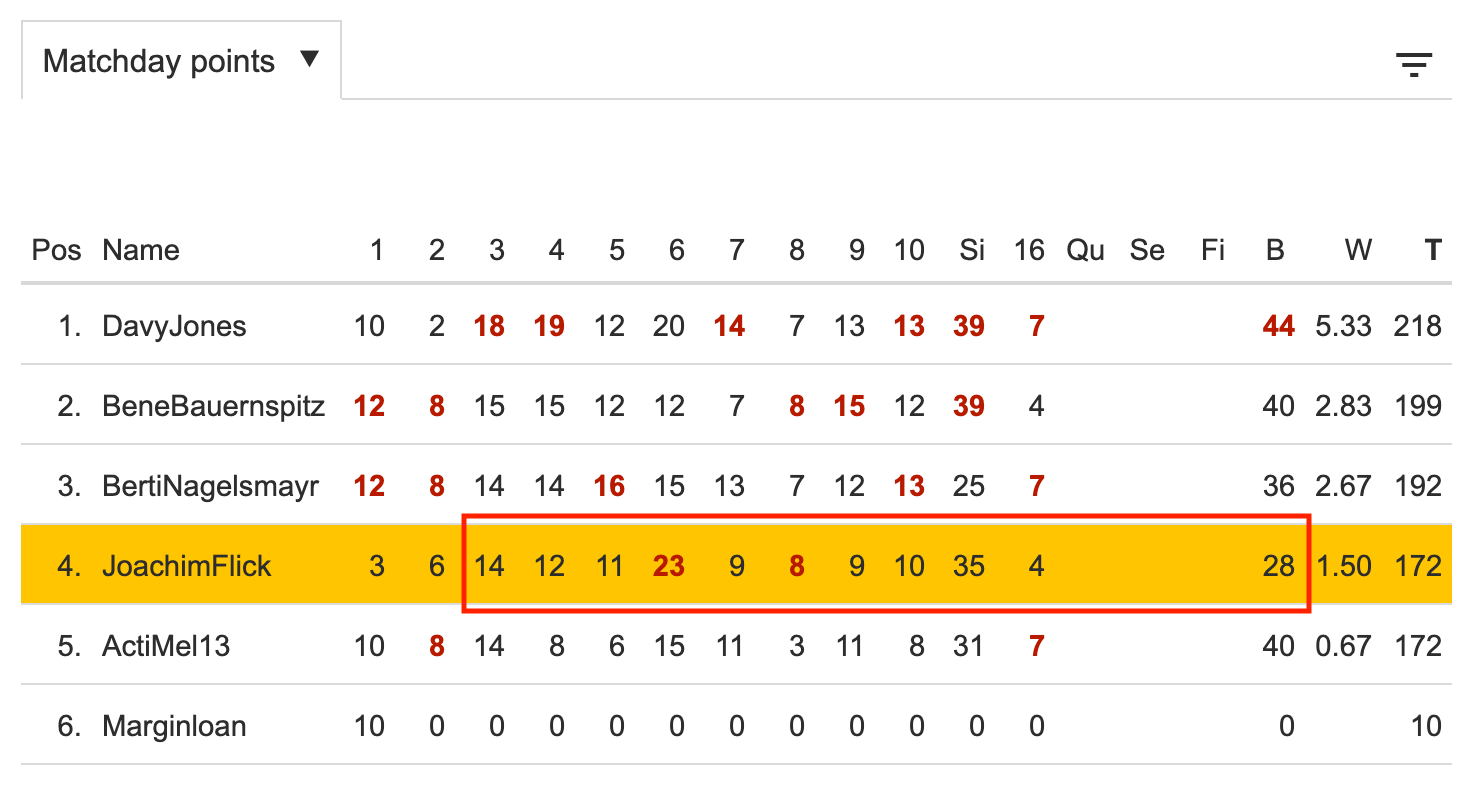
And if you really want to know: Yes, my World Cup picks with friends did improve. But between botching my pre-tournament bonus picks and not building this skill until matchday 3, the late high-risk push was not enough to close the gap.
Questions, rough edges, better examples: find me in Runme's Discord. I would like to hear what happens when runme eval meets your own agent workflow. And stay tuned for the Runme Eval Skill to put your Claude on task evaluation auto-pilot.
Resources
- Hamel Husain's
F*** Your Skills (And Mine Too)via Hugo Bowne's X - Harbor Framework
Show Us Your Agent Skills: How to Evaluate Agentic Workflows- Terminal-Bench
- Guillermo Rauch on testing
- Showcase repo:
world-cup-picks-reportskill world-cup-picks-reportscoring rubric- Concrete
world-cup-picks-reportscoring output - Agent Trajectory Format (ATIF)
- Published
world-cup-picks-reporteval history world-cup-picks-reportpackaged end-to-end task- Concrete
world-cup-picks-reporttrajectory - Runme task evals docs